Strut Regassing - Upper Hutt. Should You Regas or Replace Gas Struts
If your bonnet, boot lid, tailgate or canopy door is slowly sinking instead of staying open, the gas struts are probably on their way out. It often starts as a minor annoyance. Then one day you are holding the bonnet up with your shoulder, wedging the tailgate with a broomstick, or asking someone else to stand there while you load the boot.
That is more than inconvenient. A weak gas strut can drop without warning, damage panels, trap fingers, or make a simple check under the bonnet harder than it needs to be.
At Bristols Automotive Specialists, we have had a couple of customers ask about gas strut regassing recently, so it is a good time to explain how it works, when it makes sense, and when replacement is the better call.

What gas struts do
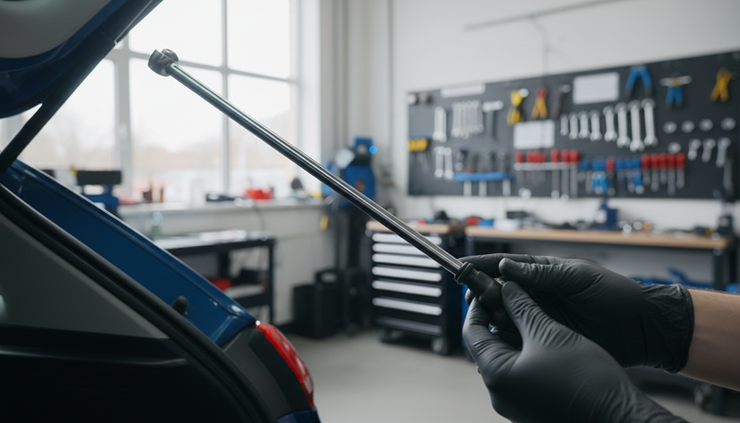
Gas struts are small but useful lifting supports. They are gas-filled cylinders that help lift, hold, or control the movement of panels and doors.
You will commonly find them on:
Vehicle bonnets
Boot lids
Hatchbacks and tailgates
Ute canopies
Toolboxes
Campervans and motorhomes
Classic car panels
Caravan storage doors
Machinery covers and access panels
A gas strut usually contains compressed nitrogen gas and a small amount of oil. The gas provides the force that helps lift and hold the panel open. The oil helps lubricate and control the movement, so the panel does not fly up or slam down too sharply.
When the strut is working correctly, you barely notice it. The bonnet rises smoothly. The boot lid stays open. The canopy door lifts without a fight.
When it fails, you notice straight away.
Why gas struts lose pressure
Gas struts do a simple job, but they operate under pressure every time they move. Over time, the seals wear and tiny amounts of nitrogen can escape. This usually happens slowly, so the loss of lifting force can creep up on you.
Common signs of a weak gas strut include:
The bonnet or boot lid rises part-way, then stops
The panel slowly drops after being opened
The strut feels weaker in cold weather
One side lifts more strongly than the other
You hear creaking, binding, or clicking near the mounting point
Oil appears around the rod or cylinder
The panel drops suddenly instead of lowering smoothly
Cold weather can make weak struts feel worse. Gas pressure drops as temperature falls, so a strut that just manages in summer may struggle on a cold morning. That does not always mean the strut is completely failed, but it is a clear sign it may be near the end of its useful life.
A failing strut can also place extra strain on hinges, brackets, and panels. If one side is weak and the other is stronger, the panel may twist as it opens. That can lead to poor alignment or damaged mounting points, especially on heavier tailgates and canopy doors.
Regassing can be a smart repair
In many cases, gas struts can be regassed. That means the strut is recharged with nitrogen to restore its lifting force.
For a strut to be suitable, it needs to be serviceable and in good physical condition. If the rod, cylinder, seals, and mounting ends are all sound, regassing can give the strut a new lease of life.
Regassing can make sense when:
The strut is otherwise in good condition
The original strut is hard to source
The vehicle is older or uncommon
The strut is a special length or force rating
The customer wants to avoid unnecessary replacement
The repair is more cost-effective than buying new
This can be especially useful for classic cars, campervans, motorhomes, and aftermarket canopies. Sometimes the original part is no longer readily available, or a replacement needs to be matched carefully. In those cases, checking whether the existing strut can be regassed is often worthwhile.
A serviceable gas strut does not always need to be thrown away. If the body is sound and the seals can hold pressure, regassing may be the practical option.
Regassing may also reduce waste. If a good-quality strut only needs pressure restored, recharging it can keep a usable part out of the scrap bin. That said, it only makes sense when the strut is safe, serviceable, and likely to hold pressure after the work is done.
Why you should not rely on a broomstick or prop
It is common to see a weak bonnet or tailgate propped up with a broom handle, timber offcut, or whatever happens to be nearby. It might get you through the moment, but it is not a safe fix.
A makeshift prop can slip. It can move if the vehicle rocks, the wind catches the panel, or someone bumps it. If the strut has failed completely, the full weight of the bonnet or tailgate can drop suddenly.
That can cause:
Hand and finger injuries
Head or shoulder injuries
Damaged glass or panels
Bent hinges
Cracked trim
Strain on one side of the vehicle body
The risk is higher with large tailgates, ute canopy doors, motorhome hatches, and heavy toolboxes. These panels can be awkward to hold and difficult to control once they start dropping.
There is also a practical side. If you work from your ute, travel in a campervan, or regularly load the boot, weak struts become a daily irritation. Fixing them makes the vehicle easier and safer to use.
Replace struts in pairs when needed
Many bonnets, tailgates, and canopy doors use two gas struts. If one has failed, the other is often not far behind. They have usually done the same amount of work and are the same age.
Replacing or regassing only one side can sometimes leave the panel lifting unevenly. One new or freshly charged strut may fight against an older weak one. That can twist the panel, stress the hinges, or make the movement feel wrong.
In some cases, one side can be repaired on its own. In many cases, doing both gives a better result. The inspection will usually make this clear.

Bristols will recommend the repair that makes sense
At Bristols Automotive Specialists, 40 Ward Street, Upper Hutt, the goal is not to replace parts for the sake of it. The goal is to find the best repair for the job.
That might mean regassing a suitable gas strut. It might mean sourcing the correct replacement. It might mean checking the mounting points, brackets, or surrounding hardware to make sure the problem is fixed properly.
If your bonnet, boot lid, tailgate or canopy door is no longer staying open, bring it in and let us take a look. We will inspect the struts, explain what we find, and recommend the most practical and cost-effective option.
A well-supported panel should lift smoothly, stay open securely, and close without a fight. If yours does not, the fix may be simpler than you think.


Comments